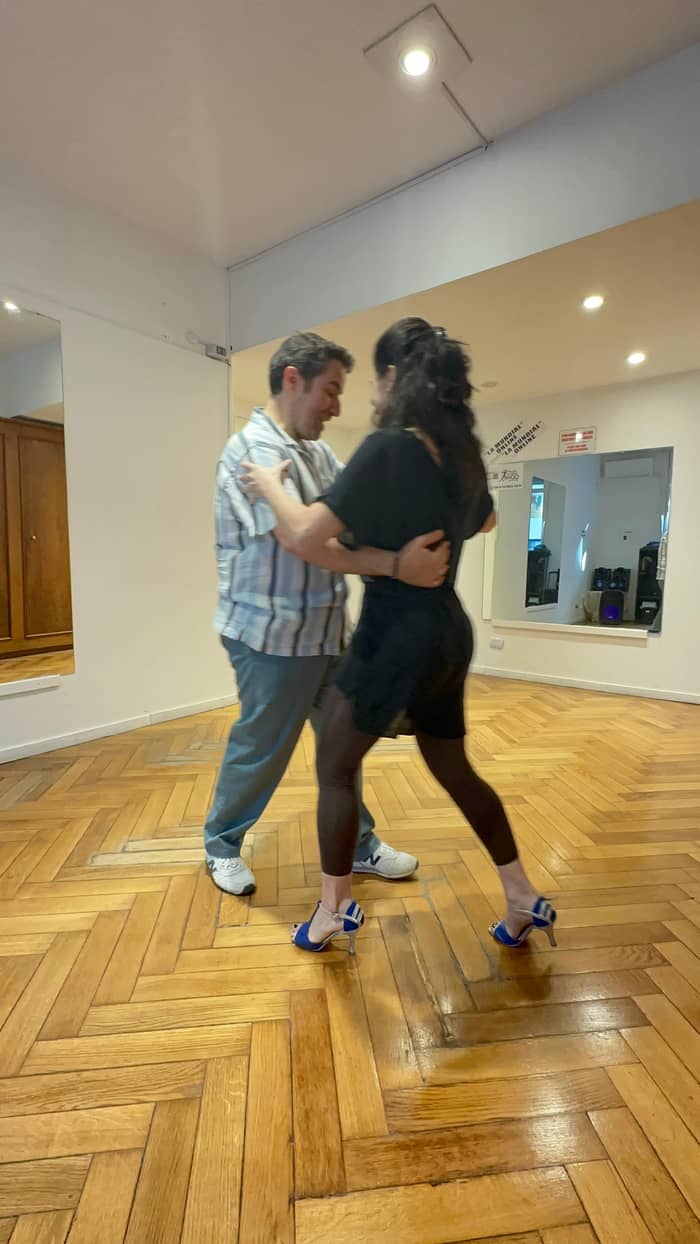
Most flexible
Private hour
Studio near your hotel
- Length1 hour
- LevelAll levels
- Book36 hours ahead
Guides
Language
Currency
Look up datesfrom $39 · cancel without payingHands-on checklist
Private tango lesson in Buenos Aires
★ 4.9 · 304 written reviews
Brief answer
A beginner tango class in Buenos Aires starts with posture, the embrace and the walk; you need no partner, just shoes that pivot, and a handful of classes can give you a basic sequence.
Before your first class
Prep list · 11 items
Mark each item when done. Progress is stored on this device.
0 / 11 ready
You are all set. Only the date and the time of your lesson are left to pick.
Secure your spotNobody walks into a first tango class knowing what to do with their arms. Here is how that hour usually unfolds, what to wear on your feet, how to find the studio and what to do the morning after.
Editorial team, tangolessonbuenosaires.click · Updated November 12, 2026 · Reading: 8 min
In brief
Most people arrive at their first beginner tango lesson in Buenos Aires expecting choreography, and leave having spent much of the hour simply walking. That is not a shortcut or a warm-up, it is the dance itself. The city tourism board puts it plainly: social dancers place the heart of tango in the embrace and in the connection with a partner, not in elaborate steps.2 Your teacher will probably build the whole hour around that idea.
Tango is improvised, and that changes how it is taught. There is no fixed sequence to memorise, so a good first class gives you a small vocabulary and a feeling for how a couple moves together. The tourism board is honest about the effort involved: the dance asks for patience, a single class shows you how it works, and somewhere around 4 or 5 lessons can give you a basic sequence solid enough to try on a real dance floor.1
Keep your expectations there and the hour becomes fun rather than frustrating. You will not leave dancing like the couples in the shows, and nobody expects you to. What you can leave with is posture, a calm walk, the first shape of the embrace and enough understanding to enjoy watching other dancers. That is a real souvenir of the city, and the start of something you can carry home.
Ways to start
| Format | Length | Who teaches | Languages |
|---|---|---|---|
| Private lesson near your hotel | 1 hour | A professional dancer | Spanish, English |
| Private lesson in a dance hall | 1 hour | An Argentine instructor | English, Portuguese, Spanish |
| Group class with mate | 2 hours | A teacher with a group | English, Portuguese, Spanish |
Formats as the GetYourGuide listings describe them; prices start from $30 and are from-prices.
A typical beginner hour moves from standing to walking to turning. It often opens with posture: chest lifted, weight over the balls of the feet, shoulders relaxed. Then comes the embrace, which in the close milonguero style of the dance halls wraps around the partner rather than holding them at arm's length.4 Teachers usually spend time here, because everything that follows, every step and every turn, travels through it.
Next is the walk. Leaders learn to propose a step with the chest instead of the arms, and followers learn to wait for that proposal and answer it. It sounds simple and it is the hardest part of tango, so expect to repeat it many times to the music. Once the walk feels steady, many teachers add a pause, a change of weight and a first figure such as the ocho, a pivoting figure that appears in almost every tango and draws a looping shape on the floor.
Between exercises, a teacher will play a few tangos and ask you to dance what you have learned, however small. Use those moments to listen rather than to count. Golden-age tango, the sound of the big dance orchestras of the 1920s to the 1950s, has a steady beat that beginners can follow.5 Ask which orchestra you are hearing; knowing a few names makes the music far less foreign the next time you hear it in a café.
Dress for the season
Mean afternoon highs measured by NOAA at the Buenos Aires Observatorio station over 1991 to 2020; summer lessons run warm and winter ones cool.6
Shoes matter more than anything you wear above the ankle. The ideal first-class pair has a smooth sole that lets you pivot, a heel you can stand in for an hour and a strap or lace that keeps your foot inside the shoe. Leather-soled street shoes work well, and so do jazz or ballroom shoes if you already own a pair. Rubber trainers grip the floor and fight every turn, and sandals or flip-flops leave toes exposed to a partner's heel.
Dancers at the milongas often arrive in street shoes and change into dance shoes at the table, which is a habit worth copying even for a lesson.3 Carry the clean pair in a bag so the soles stay free of grit. For clothes, choose something you can move in that does not catch on a partner: trousers or a skirt with room to step, and a top without large buckles or brooches at chest height, where the embrace sits.
Think about the season too, since the studios rarely feel the same twice. In January the city's Observatorio weather station averages daily highs of 29.6°C, against 15.1°C in July.6,6 A summer studio warms up quickly once everyone is walking, so a light shirt and a small towel help. In winter, dress in layers you can peel off once you are moving, because the body warms up fast in the embrace, and bring water in every season.
Choose your start
Tell us who is dancing and what you hope the hour gives you.
If I am on my own and a little shy
A private hour
The teacher dances with you, in a studio near your hotel.
If We are a couple on holiday
A private hour for both
The listing is described for couples and all levels.
If I want to meet other dancers
A group class
A 2-hour class with mate and snacks, shared with other learners.
If I want to see a milonga the same night
Lesson plus milonga night
A shared lesson, then a real milonga with a guide and hotel pickup.
If I only have a weekend
Book a weekday slot early
Weekend availability can be very limited in some areas.
Pick your first hour
Most flexible
Studio near your hotel
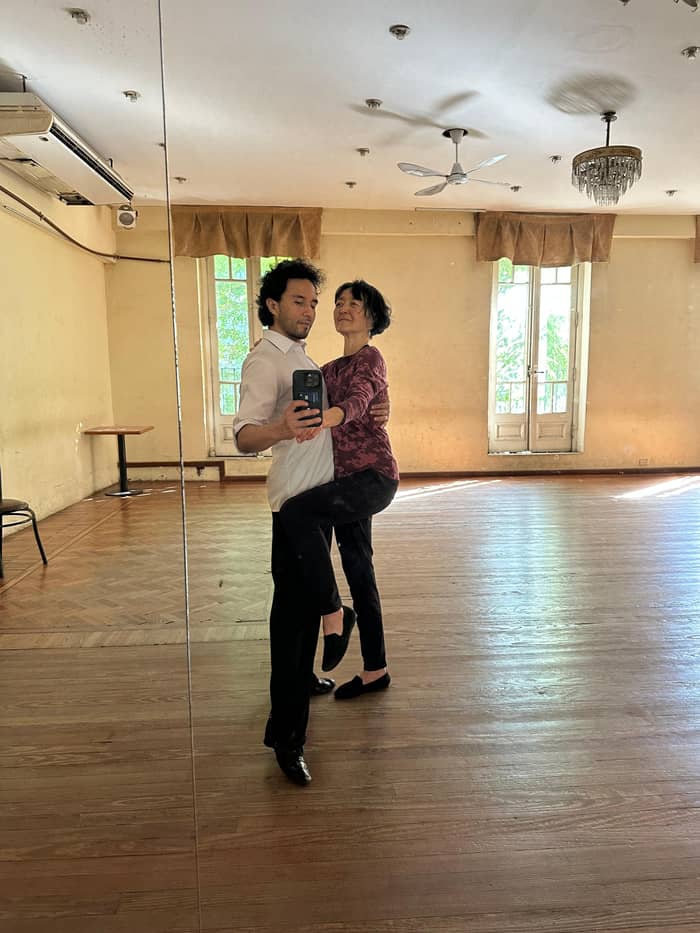
Trilingual
Private, with an instructor
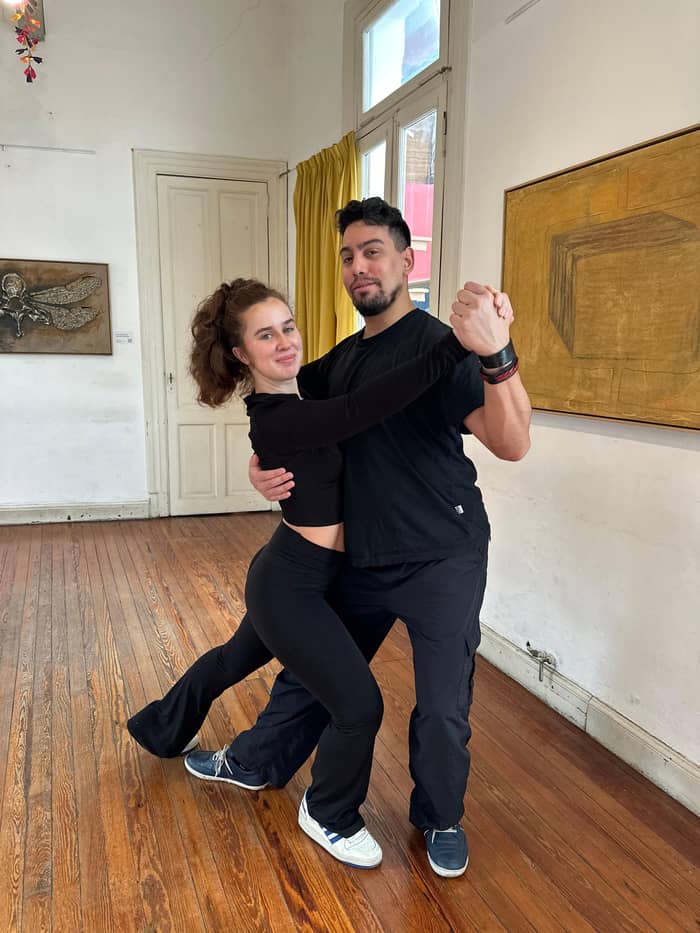
Social start
Shared with other learners
You do not need to bring a partner. In a private lesson the teacher dances with you, which is the fastest way to feel what a good lead or a good follow is like. The private hour sold on this site is described for beginners, couples, families with kids and experienced dancers, so the same booking works for a solo trip, a honeymoon or a family holiday. The teacher simply adapts the hour to whoever walks in.
Couples get something extra from a first lesson: a shared language for the rest of the trip. Many couples find it useful to swap roles for a few minutes, because leading for a moment teaches a follower what the leader is trying to say, and following teaches a leader how unclear an arm-push feels. If you plan to keep dancing together at home, ask the teacher for a short practice routine you can repeat.
Children usually enjoy the walking games and the music more than adults expect, and a family lesson tends to be lighter and full of laughter. Keep it simple: let the youngest dance with the teacher first, then rotate. Teenagers often pick up the walk faster than their parents. Plan the lesson for a time when nobody is tired or hungry, since an hour of standing and walking is more physical than it looks.
Price your first hour
Choose a group class and how many of you will dance to see the starting totals. The private hour is missing on purpose: its listing does not say how the price grows with each dancer.
Compare 3 choices
Choose a group class and how many of you will dance to see the starting totals. The private hour is missing on purpose: its listing does not say how the price grows with each dancer.
≈
View≈
View≈
ViewStarting prices on GetYourGuide, exchanged at the ECB reference rate. The booking page gives the exact price.
The hour, step by step
Before
The studio address comes back by email.
Arrival
Dancers swap street shoes for dance shoes at the table.3
First minutes
The close hold of the dance halls comes from the 1940s.4
Middle
The heart of tango is the embrace and the connection, not the steps.2
Last minutes
Golden-age music has a steady beat for beginners.5
Afterwards
4 or 5 classes can give you a basic sequence.1
Tango is gentle on the body compared with many dances: there are no jumps, and the basic walk is close to an ordinary walk. Still, a first hour asks your calves, ankles and back to hold a posture they are not used to. If you have a knee, hip or back problem, mention it when the teacher greets you, and ask to sit out any turn that hurts. A good teacher simply adapts the exercise, and nobody in the room will think less of you for it.
Pivots load the ankles and knees, so keep them soft and let the hips turn. If your shoes have heels you rarely wear, consider a lower pair for the first class. Blisters are the commonest injury, and plasters in your bag solve them. If you are pregnant or recovering from surgery, ask your doctor first, and tell the teacher at the start so the embrace can stay open, light and comfortable throughout.
Comfort is also about personal space. The close embrace is a choice, not a rule: many teachers begin in a more open hold and close it only when both dancers feel at ease. Say what you prefer at the start. Clean breath and fresh clothes are part of tango courtesy in every studio and dance hall, and teachers notice the student who arrives ready to stand close. A mint before the class is a small kindness.
Video
Tango Inside Out on YouTube · The video waits until you tap play to load.
social dancers say the true essence of tango lies not in fancy steps, but in the embrace and the connection with their dance partner
The private lesson is held in the nearest available studio to your hotel, and studios can be booked Downtown, in Palermo or in other neighbourhoods. Send your hotel location after booking: the studio address comes back by email. Do not go to the Obelisco, which is only the default address the booking system asks for; lessons never happen there. Save the email offline in case your phone loses signal.
Book with some margin. Some areas have very limited availability at weekends or when the lesson is booked less than 36 hours ahead, so a weekday booking made a couple of days early gives you the widest choice. Transfers are not included, which is rarely a problem when the studio is near your hotel. Check the address on a map the evening before and look at the street door: many dance spaces sit upstairs behind an unmarked entrance.9
For the trip itself, the subte and the buses need a rechargeable SUBE card, which you can buy at subte stations, kiosks and the city's tourist help points.7 The city's BA Cómo Llego map works out the route for you, whether you walk or ride.10 Licensed cabs cruise the busy avenues, and the city government's BA Taxi app can call one to your door.11 Drivers find places by corners, so name the closest intersection instead of the street number.12
The morning after a lesson is the best time to fix what you learned. Walk across your hotel room to a tango, slowly, with the posture you practised. Followers can practise waiting for the step; leaders can practise starting it from the chest. A short daily session of that is worth more than an hour of videos. Film yourself if the teacher allows it, and compare the clip with how the step felt. Posture problems are much easier to see on a screen than to feel.
Then decide where you want to go. If the first hour made you curious, book a second private lesson to consolidate the walk, or join a group class to dance with many partners. The tourism board notes that many milonga venues hold a class before the dance begins, which is a gentle bridge from the studio to the floor.8 Our milongas guide explains the codes and the etiquette of the floor before you try one.
If you have more time, treat each tango class in Buenos Aires for beginners as part of a short series rather than a single visit. A handful of classes spread over a week, with an evening at a milonga to watch, will take you further than a long day of lessons. Keep notes of what each teacher corrected, because the same comments tend to return. And keep listening: the music is the best teacher you can take home.
FAQ
In a private lesson the teacher dances with you, and the private hour on this site is described for solo travellers, couples and families.
The private lesson sold here lasts 1 hour, with a professional dancer in a studio near your hotel.
Leather-soled shoes with a secure strap work best; rubber trainers grip and fight every turn. Carry a clean pair in a bag.
Studios are booked Downtown, in Palermo or elsewhere, and the address arrives by email. Lessons never take place at the Obelisco.
The city tourism board says that number of classes can be enough to master a basic sequence and brave a milonga floor.1
The private lesson is described for all levels, including families with kids. Keep the hour playful and let children dance with the teacher first.
Some areas have very limited availability at weekends or when booked less than 36 hours ahead.
Change of plans? Cancel 24 hours or more before the lesson for a full refund; reserving costs nothing upfront either.
Sources
Learning tango in Buenos Aires? Ask a real person here.