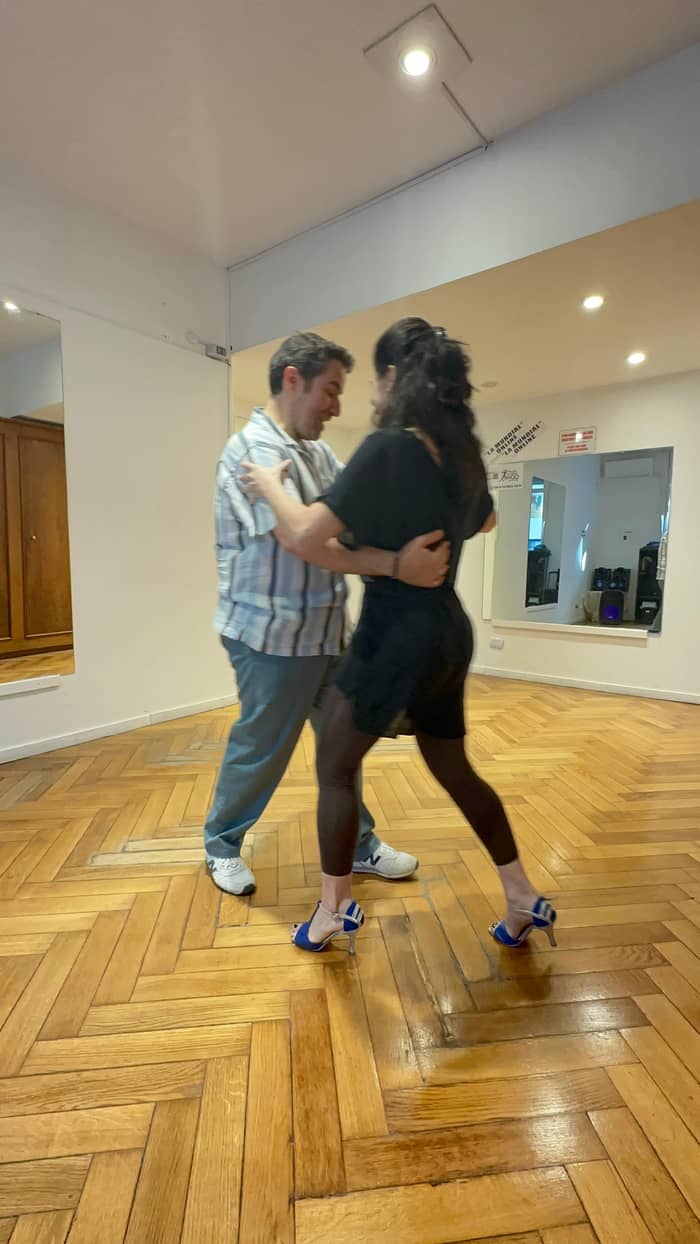
Most attention
Private hour
A dancer just for you
- Length60 minutes
- LevelsAll welcome
- StudioNear your hotel
Guides
Language
Currency
Look up datesfrom $39 · cancel without payingDeciding made easy
Private tango lesson in Buenos Aires
★ 4.9 · 304 written reviews
Brief answer
Book a private tango lesson in Buenos Aires if you are a couple or want corrections at your own pace, and a group class if you want company and partner changes.
Choosing essentials
Two questions, one format
Say who is dancing and what you want from the evening, and the format that fits appears with its starting price.
Suited to you
from $39
60 minutes with a professional dancer in a studio near your hotel, for every level.
Suited to you
from $30
2 hours in a shared class, taught in English, Portuguese and Spanish.
Suited to you
from $96
3.5 hours: a shared lesson, then a guided milonga for up to 6, with hotel transfers.
One teacher for you, or one teacher for a room of strangers. Both work, for different people. Here is how to tell which one you are before you book.
Editorial team, tangolessonbuenosaires.click · Updated November 12, 2026 · Reading: 7 min
In brief
A private tango lesson in Buenos Aires gives you a professional dancer for a full hour, and every minute of it is spent on your body, your balance and your partner. The lesson sold on this site is exactly that: 60 minutes, private, at whatever level you arrive with. A shared class gives you a teacher, a room of other learners and a change of partner every few songs, which is closer to what a real night of dancing feels like.
Neither format is the better one in general. The city tourism board describes tango as an improvised dance that asks for patience, and says one class gives an insight while four or five can be enough for a basic sequence at a milonga.1 Whether those first classes are private or shared depends on what you need most: attention, or practice with many different partners.
A good rule of thumb is to look at your companions and your nerves. Couples and shy beginners tend to get more from a private studio, where nobody watches. Outgoing solo travellers often prefer a shared class, where they meet people and dance with everyone. If you cannot decide, the order that tends to work is a private hour first and a group class later in the week.
Head to head
| Question | Private hour | Group class |
|---|---|---|
| Who is in the room | Your party only | Other learners |
| Starting price | $39 | $20 |
| Length | 60 minutes | 1 to 2 hours |
| Where | Studio near your hotel | Fixed hall |
| Partners | Teacher or your partner | Rotating strangers |
| Best for | Couples, shy beginners | Solo, social learners |
Lowest advertised prices and durations of the private hour, the first-steps class and the mate class, as GetYourGuide lists them.
The private lesson booked here is led by a professional tango dancer and is open to first-timers and seasoned dancers, couples and parents bringing children. Teaching is in Spanish or English. The operator looks for a studio near where you sleep, availability allowing, and names Downtown and Palermo among the districts it books.
Ask a social dancer here what tango is about and the answer is rarely a step: it is the embrace, and the link with whoever you hold.3 That is what a private hour can work on properly. In a crowded room, a teacher shows the step and moves on; alone with you, a teacher can stop the music, adjust a hand on your back or the angle of your chest, and try again until it feels right.
A private hour also bends to your plans. The listing says lessons run every day, with flexible scheduling to fit your itinerary. For a traveller with a full programme of sights, that flexibility matters as much as the teaching: you can slot the lesson into the late afternoon, rest, and still have time for dinner before the city really wakes up.
Time on the floor
Length of each format in hours, from the listings on GetYourGuide.
A group tango class in Buenos Aires usually opens with a demonstration, then pairs up the students and walks between them while they practise. One shared option pairs 2 hours of dancing with mate and snacks, costs from $30, and its teachers switch between English, Portuguese and Spanish. A first-steps class of 1 hour, which adds a brief history of tango, starts from $20.
Size changes everything. In San Telmo, one class mixes all levels but never takes more than 10 students. At the other end of the scale, the classes held before a milonga can be large, because anyone who arrives early joins in, and the city notes that many milonga venues offer them.4 The bigger the room, the more you learn by copying the couple next to you rather than from the teacher.
Partner rotation is the hidden benefit of a group. Dancing with strangers of different heights and styles teaches you to lead or follow clearly, which is the skill a real milonga will test. It is also the hidden cost: uneven numbers can leave someone sitting out, and a beginner leading another beginner can repeat the same mistake for a whole song without anyone noticing.
Formats
Most attention
A dancer just for you
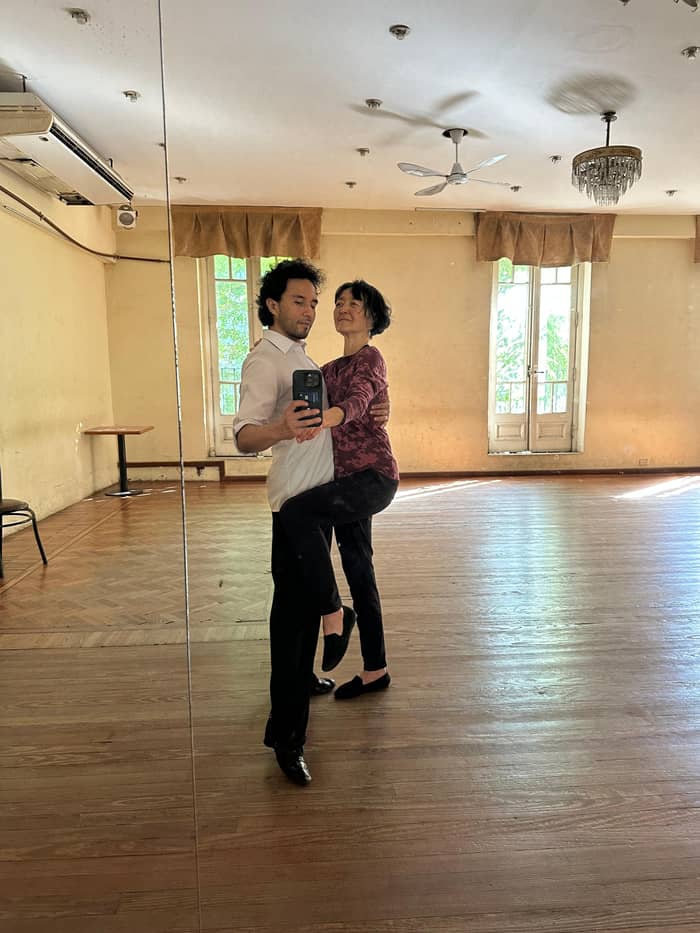
Most social
Learn in company
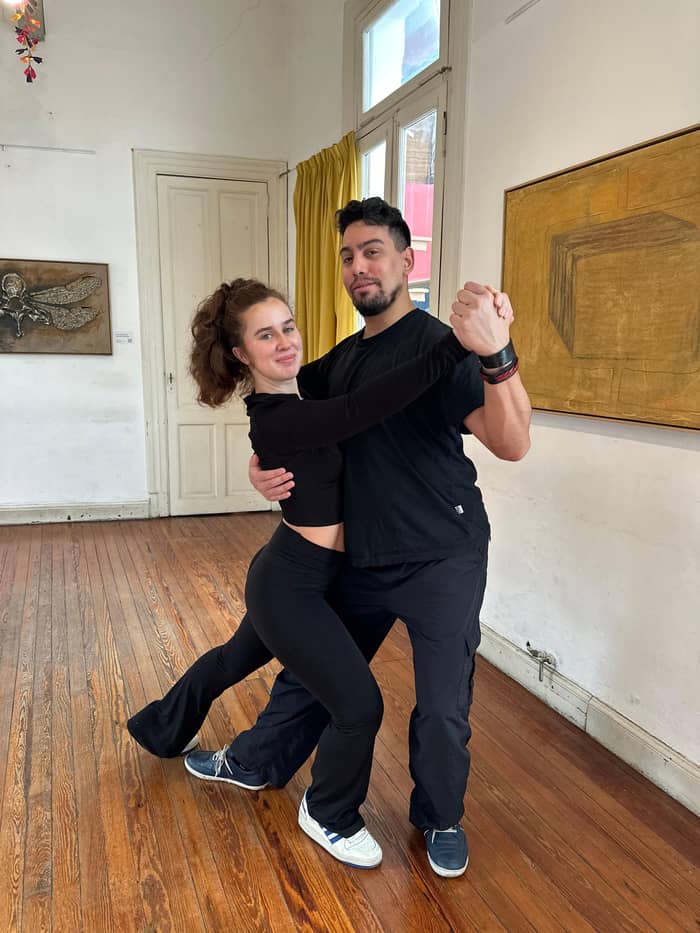
Real dance floor
Guided night out
Couples are the strongest case for a private hour. In tango one partner leads and the other follows, and most early problems sit between leader and follower: a tight arm, a step taken too soon, a lean in the wrong direction. A teacher who watches only you can fix those, and the private listing names couples among the guests it welcomes. You leave with a shared vocabulary you can practise in the hotel room.
Solo travellers can go either way. Alone in a studio, you dance with the teacher and never sit out a song, and the listing welcomes solo learners as well as couples. In a shared class you will be paired with strangers, which is sociable but depends on how many leaders and followers turn up that night. If you are travelling alone and want to meet people, a group class with mate is the easier social start.
Families with children are named by the private listing as welcome. A private studio suits them, because children lose patience in a crowded room and parents can laugh at their own mistakes without an audience. A group class works for teenagers who like a challenge, but younger children usually do better when the teacher can turn the hour into a game.
Compare formats
Pick a shared format and the number of dancers to compare starting totals. Private formats are left out, because their listings never say how the total changes with head count.
Compare 4 choices
Pick a shared format and the number of dancers to compare starting totals. Private formats are left out, because their listings never say how the total changes with head count.
≈
View≈
View≈
View≈
ViewStarting prices on GetYourGuide, exchanged at the ECB reference rate. The booking page gives the exact price.
A combined evening
Early evening
The guided night collects you, since milongas are rarely in tourist areas.
First hour
A professional dancer teaches the basics before the milonga.
At the milonga
Formal milongas keep traditional codes and ask for smart dress.2
Later
Dance with your group, or keep watching from the table.
End of night
Transfers back to the hotel are part of the night.
Book early if your dates are fixed. Weekend slots, and anything booked inside 36 hours, can be very hard to get in some districts, the listing warns. After booking you send your location, the operator matches you with a studio near it, and the address is emailed to you. The Obelisco that appears on the booking system is only a placeholder address, not the meeting point.
Getting there is up to you, because transfers are not included. For a studio in your own neighbourhood that often means a short walk. Otherwise take a licensed taxi, which runs on a meter and is paid in pesos, or book one through the city app BA Taxi.5 The subte runs until midnight on Saturdays, which covers most evening lessons.6
Group classes ask less planning. Most run at fixed times in a fixed hall, and you turn up, pay or show your booking, and dance. One group class asks you to ring the bell at the exact address you are sent, so save it on your phone before you leave. A class held before a milonga usually needs no booking, but arrive early if you want space on the floor.
Video
Google Local Guides on YouTube · The video waits until you tap play to load.
social dancers say the true essence of tango lies not in fancy steps, but in the embrace and the connection with their dance partner.
Ask before booking
Some evenings join studio and dance floor. On one guided evening, 3.5 hours long, a professional dancer teaches a small group first, and a guide then leads up to 6 guests onto a milonga floor; the hotel ride both ways is part of it. Its private twin runs 4 hours, begins with an hour of one-to-one teaching in a neighbourhood studio, and costs from $135.
The guide is the point of these nights. Formal milongas encourage smart dress and the traditional codes and rituals, while modern ones are relaxed and bohemian, says the city tourism board.2 Knowing which kind you are in, where to sit and how an invitation works is hard to learn from a class, and easy to learn from someone sitting at your table.
A cheaper mix is a private lesson of 3 hours followed by a milonga, from $79, where guests pay the entrance and transport themselves. Whatever you choose, remember the dress rule the guided nights repeat: no shorts on the milonga floor. Pack one pair of long trousers or a skirt for the night out.
The city tourism board puts the threshold for a first milonga at four or five classes, enough to dance a basic sequence.1 A sensible week looks like this: one private hour at the start to set up your embrace and walk, a few shared classes to practise with different partners, and a guided or class-first milonga at the end to try it for real.4
If you have only one evening, pick by your goal. To understand how tango feels, take the private hour. To meet people and laugh, take a group class. To see a real milonga, take a lesson-and-milonga night. Several world-famous schools in the city run classes every day, and private teachers give bespoke lessons in different languages, so you will not run out of options.4
Travelling in August changes the calculation. The city hosts its tango festival every August, with free shows, classes and milongas.7 Free festival classes can replace the shared part of your week, while a private hour still pays off for the corrections a crowded festival class cannot give. Book that hour early in the month, because the city fills with dancers from abroad during the festival.
FAQ
A professional dancer works only with you for 60 minutes, at your level, near your hotel.
Shared classes begin at $20 for an hour of first steps; the longer mate class starts from $30.
Partners rotate in a shared class, and the class with mate is taught in English, Portuguese and Spanish.
The operator picks a studio close to you and emails the address; never the Obelisco.
Weekends and short-notice bookings have very limited availability in some areas.
The listing welcomes families with kids, along with beginners, couples and experienced dancers.
The private lesson is taught in Spanish and English; some group classes add Portuguese.
Sources
Learning tango in Buenos Aires? Ask a real person here.