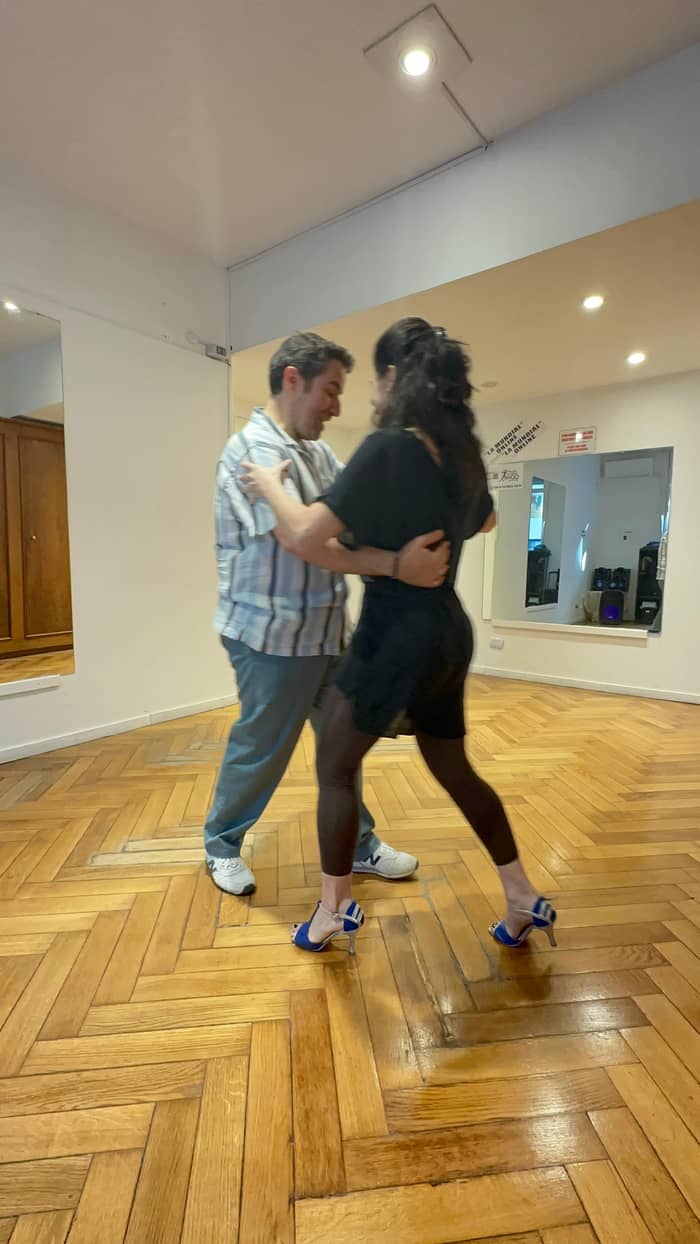
First milonga
One week
Private hour, then classes
- ClassesFour or five
- StartA private hour
- FinishA guided milonga
Guides
Language
Currency
Look up datesfrom $39 · cancel without payingPrice for your party
Brief answer
You can learn tango in Buenos Aires well enough for a first milonga in a week of four or five classes, and a month at a school with levels builds a real foundation.
Learning essentials
Compare 4 choices
Choose a shared format and a head count for a starting total per class; for the private hour, checkout gives the figure for your whole group.
≈
View≈
View≈
View≈
ViewStarting prices on GetYourGuide, exchanged at the ECB reference rate. The booking page gives the exact price.
Tango rewards patience, and the city that invented it is the best place to spend it. Here is how far you can get in one week or four, and how to plan the days.
Editorial team, tangolessonbuenosaires.click · Updated November 12, 2026 · Reading: 7 min
In brief
You can learn tango in Buenos Aires well enough for a first milonga in a few days, and you can spend a lifetime refining it. Tango, by the city tourism board account, is an improvised dance that demands patience: a first lesson reveals the mechanics, and four or five can carry you through a basic sequence among real dancers.1 Keep that promise modest and you will enjoy every step of the way.
That threshold is worth taking literally. A basic sequence means a walk, a pause, a turn and the confidence to keep going when the music changes, not a show routine. Most travellers who take four or five good classes in a week can join the slow, crowded edge of a milonga floor without embarrassing themselves, and that is a real achievement in a dance this subtle.1
At the other end, the national tango academy, created in 1990, runs a higher school whose tango course lasts three years.4 Between those extremes sits the month-long stay, which is where many visitors start to feel the music instead of counting it. Decide at the start which of these you are planning for, because the classes you book should follow from that choice.
Start with a private hour on your first or second day, to build the foundations before bad habits set in. The private lesson sold here gives you a professional dancer for 60 minutes in a studio near your hotel, at any level. Book it 36 hours or more ahead, because some areas have very little availability at short notice or at weekends.
Spend the middle of the week on shared classes. A group class with mate and snacks lasts 2 hours, and a first-steps class lasts 1 hour. In the evenings, arrive early at a milonga for its class, which many venues hold before the dancing, then stay to watch the floor for an hour.2 Watching is part of learning: you see how good dancers wait, listen and move around the room.
End the week on a real floor. If you feel shy, book the guided evening: 3.5 hours in which a dancer teaches your small group, then a guide sits with you at a milonga, with the hotel run included. If you feel brave, go alone to a relaxed milonga and dance a song or so with a patient partner. Either way, book a final private hour if you can, to fix what the week revealed.
Through the year
Mid-month hours of no sun and days of 2.5 mm precipitation or more, as recorded by NOAA station Buenos Aires Observatorio (temperatures); Ezeiza airport and La Estanzuela, Uruguay (rainfall) over 1991 to 2020.20
A month lets you join a school and climb its levels. Look for a published timetable with beginner classes that start from zero and separate classes for higher levels, like the one at Mariposita de San Telmo, a school that also runs a boutique hotel.5,8 Its teachers build lessons around ideas instead of memorised patterns, a choice the school links to freer improvising and better musicality.9
Add the other rhythms as you go. Milonga is a faster rhythm with its own music and movements, and some schools give it a separate class.10 Vals turns up at milongas too. After a few weeks you will tell tango, milonga and vals apart from the first bars, and a night out becomes far more fun. Ask your teacher to play a few of each and name them out loud while you walk.
Use the nights. Porteños dance past midnight on any weekday, and the city lists milongas in old ballrooms, cafes and local clubs, so no evening is without a floor.11,12 Go several nights a week, sit near the floor, and accept invitations from dancers whose style you like. A private hour every week keeps correcting what the milongas teach you by trial and error.
Your plan
Pick the trip closest to yours; the plan beside it is a good start.
If I only have a few free evenings
Private hour plus milonga classes
One private hour, then classes held before the dancing at milongas.2
If I have a full week
The week plan
The city reckons four or five classes cover a basic sequence.1
If I am staying a month
A school with levels
Beginner classes start from zero; higher levels follow.5
If I can travel in August
The festival trip
Free festival classes, some booked 72 hours ahead.6
If I want to go very deep
The national academy
Its higher school runs a course lasting three years.4
Ways to plan
First milonga
Private hour, then classes
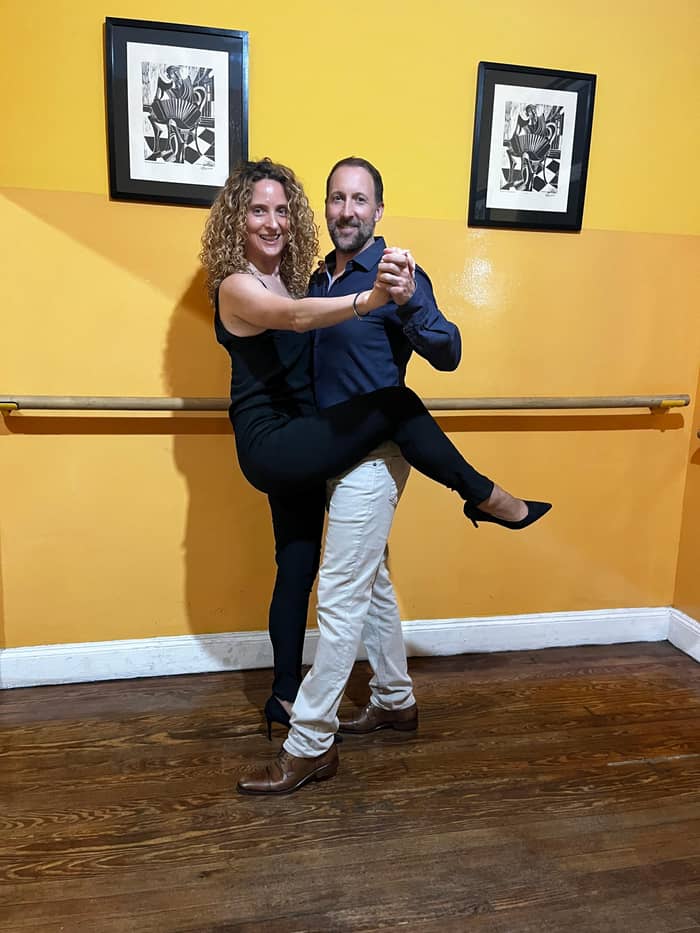
Real foundation
A school with levels
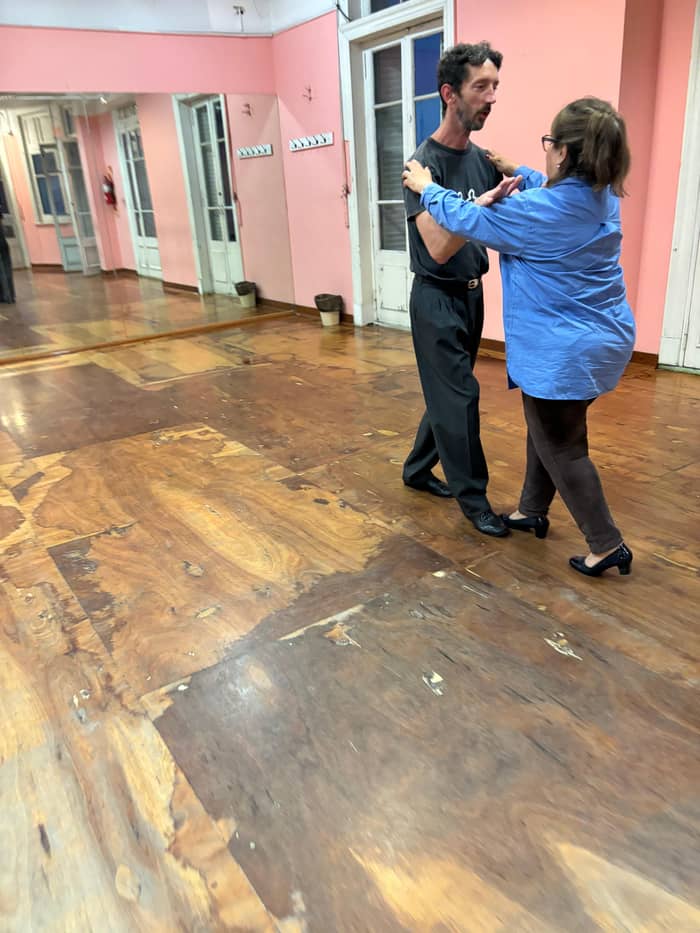
Free classes
Festival and milonga week
An intensive tango course in Buenos Aires usually means several hours of teaching a day for a week or two, mixing group classes, private lessons and guided milonga nights. What makes an intensive possible is the timetable: the city says several well-known schools teach daily, often more than once.2 Ask any school whether its intensive follows a level plan or simply stacks open classes.
You can also build your own intensive. The private lesson sold here is available every day with flexible scheduling, so a private hour every morning before afternoon group classes is easy to arrange. Add a class at a milonga in the evening and you have a full programme without paying a package premium.2 Keep one afternoon a week free of classes, so the new material can settle.
Be realistic about your body. Tango looks gentle, but hours of walking in close embrace work your feet, calves and back. Build up over the first days, rest one day a week, and stretch after each class. An intensive that leaves you injured on the fourth day teaches less than a lighter week you finish strong, with energy left for the milongas.
A tango week
Arrival evening
Book 36 hours ahead; weekends fill first.
Next morning
An hour, 60 minutes, of one-to-one work on posture, walk and embrace.
Midweek
A shared class with mate lasts 2 hours.
Evenings
Join the warm-up class most milongas run before the floor opens.2
Last night
A guided night pairs a lesson with a milonga, transfers included.
August is the tango month. Each August the city festival fills its programme with free shows, classes and milongas, and crowns stage and salon champions in a world contest.3 Its latest listing gave dates from 19 August to 2 September, with more than 50 venues in 34 neighbourhoods and nearly 800 couples from more than 45 countries.13,14 You pay nothing to get in, though certain events open for booking 72 hours in advance.6
Early August also brings the milonga week: in 2026 it ran from 1 to 7 August, with 59 milongas offering open classes, live orchestras and shows, free with a booking.15,16,17 In May the city dance championship, free to watch, qualifies dancers for the August contest; its latest listing ran from 6 to 17 May.18,19 An afternoon in the stands shows you clean social tango at its best, which is a lesson in itself.
August is winter in Buenos Aires. Average highs reach about 18.1°C and lows about 9°C at the Buenos Aires Observatorio station, so pack a warm layer for walking home after a milonga.20 The rest of the year is good for learning too, with classes and milongas every week; summer evenings from December to February are hot, with January highs near 29.6°C.20
Video
IMSO Tango by Yelizaveta on YouTube · The video waits until you tap play to load.
It is practised in the traditional dance halls of Buenos Aires and Montevideo, spreading the spirit of its community across the globe even as it adapts to new environments and changing times.
Trip checklist
Stay close to the dancing. The city tourism board groups the traditional milongas in a southern cluster, San Telmo and Constitucion, and a northern one, Palermo and Villa Crespo.21 It also links tango most closely with the southern neighbourhoods of San Telmo, Barracas, Balvanera and Boedo.22 Palermo and San Telmo give you the widest choice of classes within walking distance.
For private lessons, location matters less. For the lesson sold here, the operator matches you with a studio in your part of town, naming Downtown and Palermo among its usual districts. If you are staying a month, a flat in Palermo or San Telmo keeps both classes and milongas a short ride away. Ask for a floor you can practise on, because carpet makes pivots hard.
Plan your nights home. City buses run 24 hours a day, every day of the year, and the subte closes at about 11.30pm on weekdays.23,24 Metered licensed cabs, or the official BA Taxi app, cover the gaps.25 After dark the city advice is simple: licensed cabs only, and well-lit routes on foot.26 Save your hotel address on your phone in Spanish, with the nearest cross street, so any driver can find it.
Shoes are the first investment. For the first week, any clean shoe with a smooth sole that lets you pivot will do, and comfort beats glamour. If you stay a month, buy proper tango shoes in Buenos Aires, where the shops know every style, and break them in during classes before you wear them to a long milonga. Leather soles glide; rubber soles grip and fight every turn.
Practise between classes. Walk the line of the hotel corridor, practise your balance on one foot while the kettle boils, and listen to tango orchestras so the rhythm stops surprising you. The CCK and the Usina de Arte programme free concerts, a painless way to train your ear.27 The more you hear the music, the faster your feet follow it.
A week can cost little or a lot. Group classes start from $20 for an hour, the private hour from $39, and a guided lesson-and-milonga night from $96. Add milonga entries and taxis, and keep August in mind, when the festival classes are free.6 Spending a little more early on, on private corrections, usually saves money later, because you waste fewer group classes repeating the same mistake.
FAQ
That is the number the city gives for learning a basic sequence you can take onto a floor.1
A week of private and group classes can cover the basic sequence the city describes.1
The city festival every August brings free shows, classes and milongas.3
The Academia Nacional del Tango runs a course lasting three years.4
Milonga hubs sit around San Telmo and Constitucion, and Palermo and Villa Crespo.21
The private hour is available every day with flexible scheduling; book 36 hours ahead.
August highs average about 18.1°C and lows about 9°C at the Observatorio station.20
Sources
Learning tango in Buenos Aires? Ask a real person here.