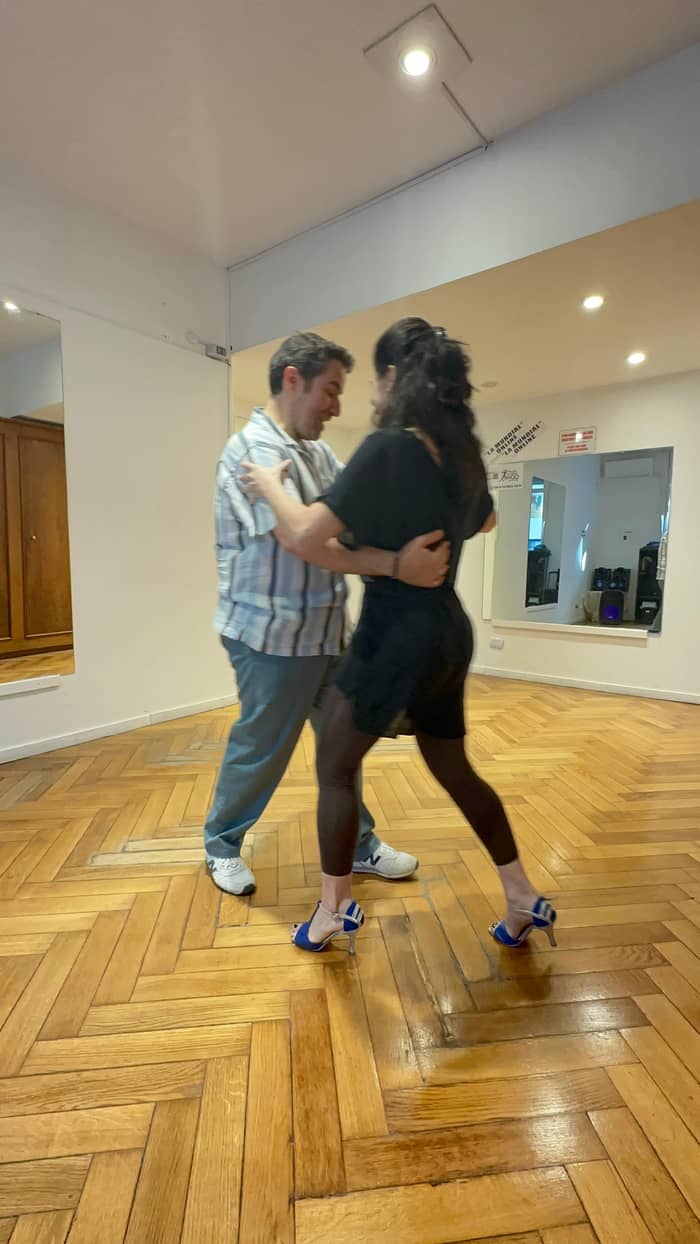
Fastest progress
Private teacher
A dancer just for you
- Length60 minutes
- LevelYours
- WhereNear your hotel
Guides
Language
Currency
Look up datesfrom $39 · cancel without payingDeciding made easy
Brief answer
No official body ranks tango schools in Buenos Aires, so choose one that teaches salon tango by level, at times that fit your stay, and try a single class first.
School essentials
Two questions, one first class
Say how long you are staying and how you like to learn, and the best first class for you appears with its starting price.
Suited to you
from $39
60 minutes with a professional dancer at your level, near your hotel.
Suited to you
from $39
Start with a private hour, then join a school timetable with separate levels.
Suited to you
from $43
1.5 hours for all levels, never more than 10 students.
Suited to you
from $30
2 hours of shared class with mate and snacks.
No public body ranks tango schools, so the choice is yours to make. This guide shows what separates a good fit from a bad one, with real timetables and formats.
Editorial team, tangolessonbuenosaires.click · Updated November 12, 2026 · Reading: 7 min
In brief
Tango schools in Buenos Aires range from a single room above a cafe to institutions with timetables, levels and teachers on staff. The city tourism board says several world-famous schools offer classes every day, sometimes several a day, while independent teachers offer one-to-one lessons in several languages.1 Nobody publishes an official league table, so the best school is simply the one that teaches the tango you want, at your level, at hours that fit your stay.
Teachers are part of the heritage itself. When UNESCO describes the tango community, it lists teachers of the art alongside musicians, dancers, choreographers, composers and songwriters.5 That is a useful reminder when you choose: you are not buying a gym membership, you are joining a lineage, and the way a school talks about music, embrace and floor manners tells you as much as its prices.
Start with a handful of plain questions. Which style does the school teach? Does it split classes by level? How many students share one teacher? And when are the classes, given that milongas often run late into the night? A school that answers all of these plainly on its own website is usually a school that runs itself well.
Where to learn
| Kind | Format | Levels | Good for |
|---|---|---|---|
| Private teacher | One to one | Any level | Couples, short stays |
| School timetable | Group classes | By level | Longer stays |
| Class before a milonga | Large group | Mixed | A first night out |
| Festival class | Large group | Various levels | August visitors |
| National academy | Courses and classes | Long course | Serious students |
Formats as described by the city tourism board, the national academy, a San Telmo school and the private lesson listing.1,10,4,7
The tango you see at a dinner show and the tango danced at a milonga are not the same, and the city treats them separately. Its dance championship has distinct categories for stage tango, for salon tango danced on a social floor, for older salon dancers, for milonga and for vals, plus a category for milongueros from around the world.2 The August festival also holds an international contest for both stage and salon dancers.8
For a traveller who wants to dance socially, salon tango is the target. It is improvised and close, built for crowded floors, and it is what you will meet at a milonga. Stage tango adds lifts, kicks and choreography designed to be watched from a seat. A school that mixes the two in a beginner class may teach you steps you can never use on a social floor.
Milonga is also a rhythm in its own right, not only the name of the dance event. One San Telmo school teaches a separate milonga class because, it explains, the music and the movements differ from those used for tango.9 Vals is a third rhythm. A school that offers all of them, at clear levels, is preparing you for a real night out rather than a single song.
The most official address in tango is the Academia Nacional del Tango, created in 1990 and presided over by the poet and lyricist Horacio Ferrer.4 It stands at Avenida de Mayo 829 and houses the Museo Mundial del Tango, an art gallery, a higher school called the Liceo Superior and rooms where dance classes are held.13,4
The Liceo Superior teaches a tango course lasting three years, which tells you something about how seriously the culture takes the art.4 Few travellers will enrol for a course that long on holiday. The building is still worth a visit for its museum, which traces the history of tango from 1850 to the present.14 Ask at the desk about the dance classes held in its rooms during your stay.
Its immediate neighbour is Cafe Tortoni, the oldest cafe in the city, founded in 1858, which hosts jazz and tango shows in its basement.15,16 An afternoon there gives you the institution, the museum and a historic cafe within a few steps, a good way to understand the culture before you take your first serious class.
Kinds of teaching
Fastest progress
A dancer just for you
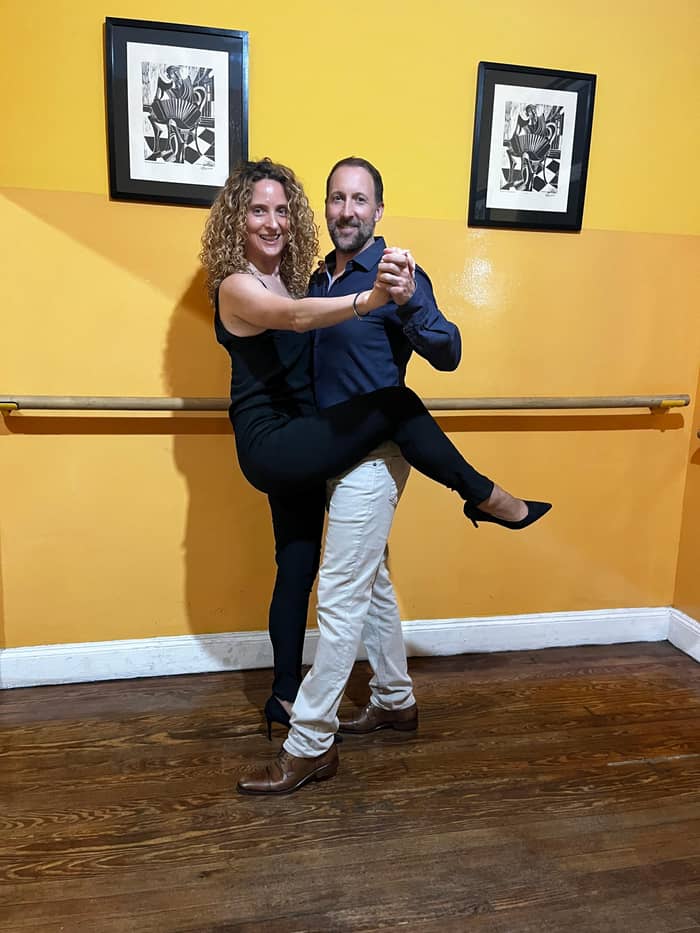
Step by step
Weekly timetable
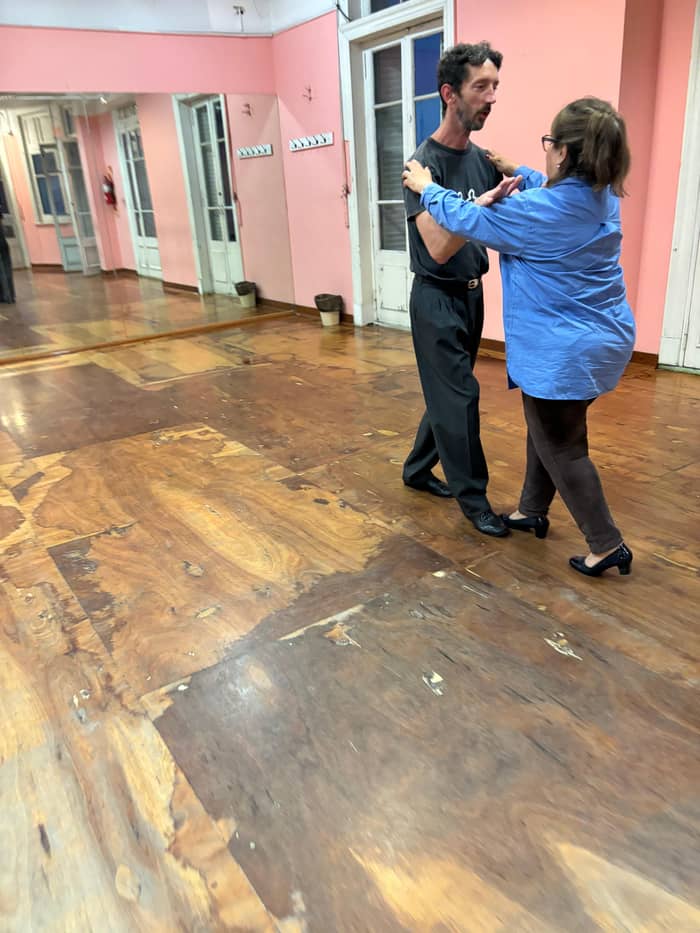
Most social
Before the dancing
A published weekly timetable is the clearest sign of a school worth trying. Take Mariposita de San Telmo, a tango school that is also a boutique hotel.17 It says students can learn social tango or train professionally, and it teaches through a method created by its director, Carolina Bonaventura.18,19 Its beginner classes are described as starting from zero, with no previous experience needed.3
Look at how the levels climb. The same school separates beginner salon classes from intermediate classes for both roles, and it says it teaches by concepts rather than fixed figures, which it believes makes improvising, following the music and using the space of the floor easier.7 Whether or not you choose that school, it is a good model of what to ask any other: what will I learn at my level, and how does it lead to the next one?
Watch out for the opposite pattern. A school with one open class for everyone, a long list of flashy figures and no talk of the embrace or the music is often tuned to tourists who will never come back. A timetable with several levels, practice sessions and both roles taught separately suggests teachers who expect you to keep dancing after your trip.
Try a teacher
Set a first group class and your head count; the starting total updates. For a private teacher, the checkout page quotes your party's figure instead.
Compare 3 choices
Set a first group class and your head count; the starting total updates. For a private teacher, the checkout page quotes your party's figure instead.
≈
View≈
View≈
ViewStarting prices on GetYourGuide, exchanged at the ECB reference rate. The booking page gives the exact price.
A learner path
First evening
A professional dancer sets up your walk and embrace.
Same week
Join a class that starts from zero, with no experience needed.3
Next nights
Many venues hold a class before the dancing.1
After a few classes
Four or five classes can be enough for a basic sequence.6
Longer stays
Move to intermediate classes for both roles.7
Lots of milonga halls open the night with a class, and the city lists milongas where you can join a class on the night.1,20 These classes are a good test of a teacher: you see how they handle a mixed room, and if you like them, you can ask about their regular school or private lessons. Expect a crowded floor and a short class.
In August the city festival turns dozens of venues into classrooms. Its programme includes concerts, exhibitions, dance classes and milongas, and entry is free, with some events booked 72 hours ahead.12 The milonga week in early August adds open classes at 59 milongas for different levels.10 In 2026 its closing night was held at La Viruta Tango Club, on Armenia in Palermo.21,22
The city dance championship, held in May (6 to 17 May in its latest listing), is another free window into the schools.23 It tours milongas and cultural spaces looking for the best dancers in the city and feeds the preliminaries of the August world championship.24 Watching the salon categories for an afternoon shows you what good social tango looks like, which is exactly what a school should be teaching you.
Video
IMSO Tango by Yelizaveta on YouTube · The video waits until you tap play to load.
The importance of learning by concepts and not by figures makes improvisation, musical interpretation and handling the space of the dance floor easier.
School checklist
For a short stay, a private teacher can beat any school. The private lesson sold here pairs you with a professional tango dancer for 60 minutes, at any level, in a studio as near to your hotel as availability allows. There is no level ladder to climb and no class to wait for; the teacher starts where you are.
Private teachers are also how many visitors find their school. A second private listing, an hour of Argentine tango priced from $50, is taught in English, Portuguese or Spanish. If you like a teacher, ask where else they teach; many split their week between private students, group classes and their own nights out at milongas.
Price private lessons against your goal. A single private hour before a group class sharpens everything you learn after it. Several private hours across a week work like an intensive course built around you. The private hour sold here starts from $39, and the listing says it runs every day with flexible scheduling.
The best tango classes in Buenos Aires for a complete beginner are short and gentle. A first-steps group hour from $20 or a private hour from $39 both start from zero. What matters is that the teacher spends time on the walk and the embrace before any figures, and that you leave wanting a second class rather than feeling lost.
For a couple, a private hour is the strongest choice, because a teacher can work on how you lead and follow each other. For a social solo traveller, a group class with mate, taught in English, Portuguese and Spanish, gives you partners and company. For a dancer with some experience, a school with separate intermediate classes for both roles will move you further than any beginner session.7
For a serious student, combine institutions. Visit the national academy and its museum, take regular classes at a school with a level ladder, and add private hours for corrections.4 If you are in town in August, let the free festival classes fill the gaps.12 Since the city reckons four or five classes are enough to brave a milonga, even a short stay is enough to begin.6
FAQ
Pick by style, levels and timetable; the city points to world-famous schools with daily classes.1
Salon and stage tango are separate categories in the city championship.2
The Academia Nacional del Tango was created in 1990 and holds dance classes in its rooms.4
Many milonga venues run a short class before the dancing starts for the night.1
Private teachers give lessons in different languages; the private hour here is in Spanish and English.1
Sources
Learning tango in Buenos Aires? Ask a real person here.